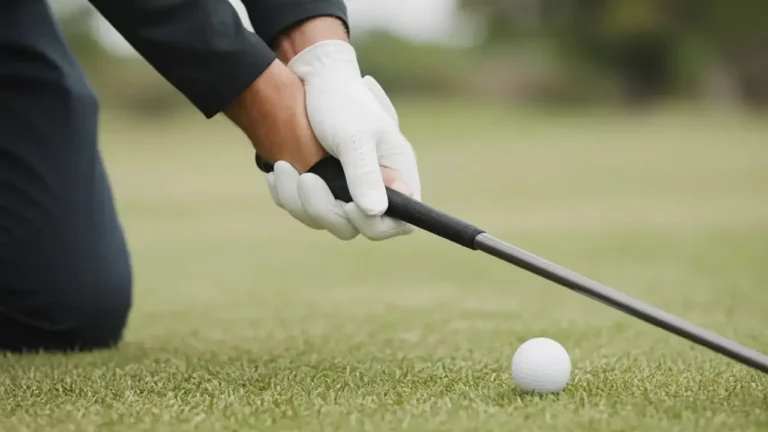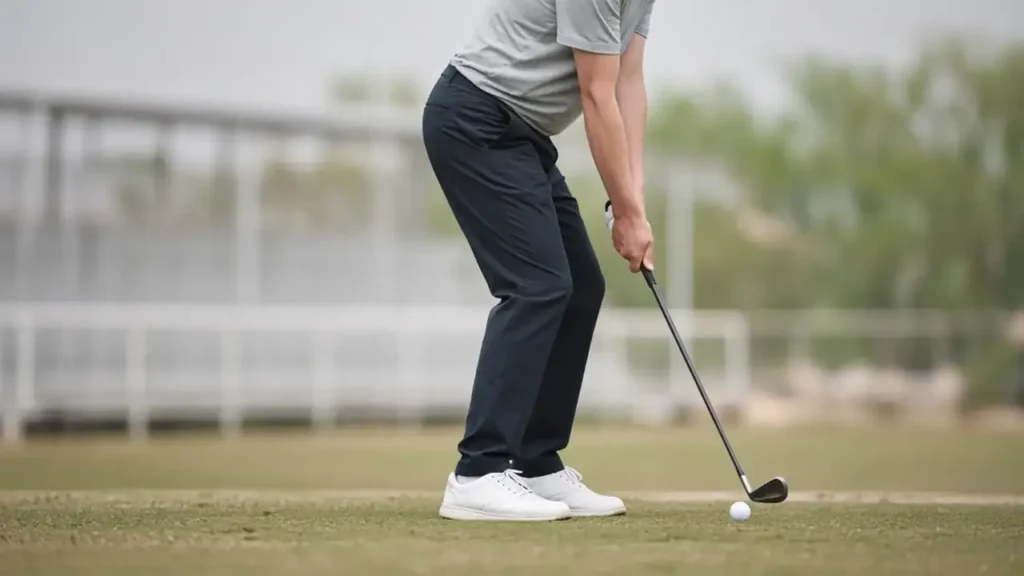
It’s tempting to skip straight to the backswing. That’s where the action is, after all. But many of the habits we see in the swing, like losing posture, standing up or swaying, start before the club has even moved. Your posture at address sets the limits for everything that follows.
Titleist Performance Institute (TPI) describes two common posture problems that are worth knowing about: S-posture and C-posture.
S-posture: too much arch
TPI describes S-posture as too much arch in the lower back at address, often from sticking the tailbone out too far. From the side, the spine looks like the letter S.
Why it matters
TPI explains that this extra curve puts high stress on the lower back muscles and lets the abdominal muscles switch off. With the core less engaged, it becomes harder to hold your posture, and TPI links S-posture to loss of posture or a reverse spine angle in the backswing.
What causes it
TPI lists several causes, including:
- being told to “stick your bum out” to make room for the arms
- not understanding how to bend from the hips
- a lack of abdominal strength
- too much knee flex with the torso too upright
- a pattern of muscle imbalances called Lower Crossed Syndrome, first documented by physical therapist Vladimir Janda, often linked to long periods of sitting
The fix
TPI’s advice is to find a neutral pelvic position, brace the core to hold it, then bend from the hip sockets and rotate without losing that neutral position. TPI also points out that you can push your hips back at address without arching your back, simply by hinging from the hips with a neutral spine.
C-posture: too much rounding
TPI describes C-posture as shoulders slumped forward at address, with a clearly rounded upper back. From the side, the spine looks like the letter C.
What causes it
TPI lists causes including limited upper-back extension, muscle imbalances around the shoulders, core instability, poor instruction on set-up, clubs that are too short, and even a grip that’s too far into the fingers of both hands.
The fix
TPI recommends learning to bend from the hip sockets rather than flexing from the upper spine, supported by exercises for upper-back extension and rotation, shoulder mobility and pulling strength.
All credit for these definitions and fixes goes to TPI.
A simple address routine
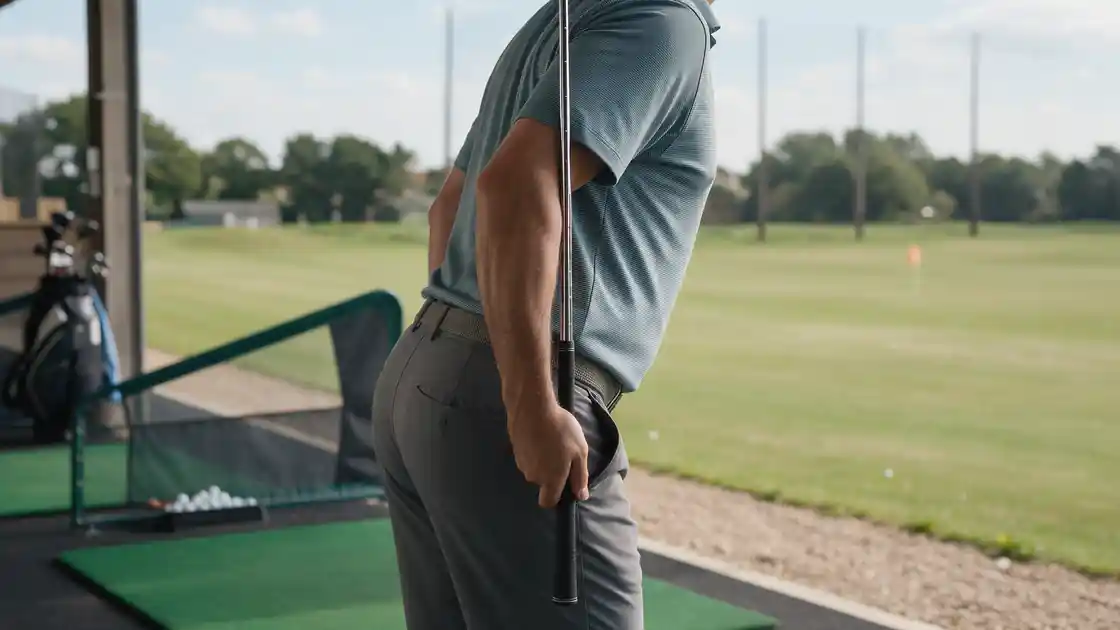
Whichever way you lean, the common thread in TPI’s advice is to hinge from the hips with a neutral spine. Here’s a routine that puts that into practice:
- Stand tall with the club held out in front of you at chest height.
- Brace lightly through your middle, as if you’re about to be nudged.
- Hinge from your hips, pushing them back, until the club reaches the ground. Keep your back neutral, neither arched nor rounded.
- Add a little knee flex, just enough to feel athletic.
- Let your arms hang naturally from your shoulders.
Do this before every shot for a week and it will start to feel normal.
Checking it on camera
Posture is notoriously hard to feel. What feels neutral may be arched, and what feels tall may be rounded. A side-on photo or video is the quickest way to check. Look at the line from your tailbone to the base of your neck. Is it fairly straight, or does it curve?
How DE-SHANK helps
DE-SHANK’s posture change score tracks whether you stand up or dip through the shot. A neutral address doesn’t guarantee a good score, but in our experience a poor set-up makes it much harder to hold your posture during the swing.
Try this: record five swings with your usual set-up, then five using the routine above. Compare your posture change scores. DE-SHANK runs on your phone, scores each swing from 30 to 100 and keeps your history on your device. Find out more on our how it works page, including tips on lighting and framing.
DE-SHANK gives estimates from one camera view. It’s designed for practice feedback, to help you spot habits and track trends.
Common mistakes
- Over-correcting. Fixing a C-posture by arching hard can create an S-posture, and vice versa.
- Too much knee bend. TPI lists this as one cause of S-posture.
- Ignoring your equipment. TPI notes that clubs that are too short can contribute to C-posture.
When to get help
If your posture feels uncomfortable or you have back pain, please speak to a qualified professional. DE-SHANK is not medical or physiotherapy advice.
Our take
Good posture is the cheapest improvement in golf. It costs nothing, takes seconds and sets up everything else. For more drills, see our Coaching Tips.
Try DE-SHANK free
See whether your set-up is helping or hurting your swing. Try the free DE-SHANK beta. It’s free during the beta.