Me and My Golf is one of the best-known golf coaching channels in the world, and it’s a British success story. It’s run by PGA professionals Andy Proudman and Piers Ward, both from Wolverhampton. According to their website, they also coach Aaron Rai, who won the 2026 PGA Championship.
Their channel has hundreds of lessons, but we want to look at an early one: “Stop Your Sway In The Backswing”, published in August 2013. It’s short, clear and still one of the best explanations of swaying we’ve seen.
DE-SHANK isn’t affiliated with Me and My Golf, and nothing here suggests they endorse our app.
The set-up: a birthday swing analysis
The video has a lovely backstory. A viewer’s wife sent in his swings as a 50th birthday present. He’d played for 15 years, had a handicap of 10 and struggled with thin and fat iron shots.
Proudman explains that as soon as they hear “thin and fat”, alarm bells ring. It usually means the bottom of the swing is before the ball, when it should be after it, so that you strike the ball and then the turf.
The diagnosis: too much weight transfer
Ward explains what they saw. As the club goes back, the weight shifts a little too far, to the outside of the trail leg. They call it a sway. The head travels too. That means the golfer has to move everything back to find the ball, which makes solid contact hard work.
They’re careful to point out that some weight transfer is good, and that the head can move a little to the side. The problem is when it’s excessive.
What they want to see instead is the weight staying on the inside of the trail leg throughout the backswing, with a stable base, no excessive lateral movement and very minimal head movement.
Drill 1: The trail-hip barrier
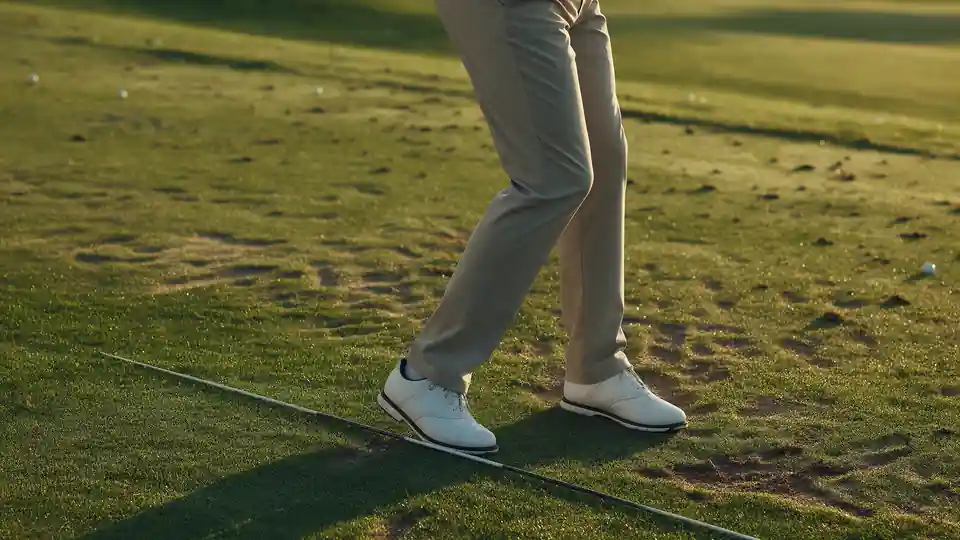
Their first drill uses an umbrella or alignment stick placed just outside the trail hip. Make a backswing without hitting it. They point out that this is the same line they draw when analysing golfers on video.
Proudman calls it great negative feedback: if you sway, you’ll hit it. It forces the right move without needing a lot of thought.
Drill 2: The head reference
Their second drill involves a helper holding an umbrella, or the end of a club, beside the golfer’s head. As you swing back, you’ll notice immediately if your upper body drifts.
They add a useful warning about feel. When you load your trail side correctly, you might feel like you’re leaning towards the target, even though on video you’ll be in a good position. Feel and real are often different.
What golfers can learn
Thin and fat often share a cause
It’s tempting to think thins and fats are opposite problems. This video shows how both can come from the same sway.
Negative feedback is powerful
Both drills give instant, honest feedback. You don’t need to understand biomechanics; you just need to avoid the umbrella.
Check feel against video
Their warning about feel is important. Many golfers resist the correct move because it feels wrong. That’s why measuring helps.
How to practise it
- Set up an alignment stick just outside your trail hip.
- Make five slow backswings without touching it.
- Hit ten half shots, then ten full shots.
- Remove the stick and hit ten more, keeping the same feeling.
If you don’t have a helper for the head drill, a camera can do the job. DE-SHANK gives you scores for hip sway and head movement on every swing, using just your phone. Compare your scores with and without the stick. Our how it works page explains the best set-up; face-on works best for now.
DE-SHANK gives estimates from one camera view. It’s designed for practice feedback, to help you spot habits and track trends.
For more drills on stability, tempo and posture, browse our Coaching Tips section.
Why we like this video
It’s warm, clear and focused on one problem. Even after more than a decade, the advice is as relevant as ever. If you enjoy it, the Me and My Golf channel has plenty more to explore.
Browse more profiles in our YouTube Coaches section.
Try DE-SHANK free
See whether you’re swaying, even without a helper. Try the free DE-SHANK beta. It’s free during the beta.