
Europe took the Solheim Cup back on Sunday 13 September, beating the United States 15-13 at Bernardus Golf in the Netherlands. The headlines rightly went to the big names in the singles. But underneath the drama were a few very ordinary golf lessons that apply just as much to a Saturday medal at your club as they do to the biggest team event in the women’s game.
Here is what happened, and what we think is worth taking away.
How the week unfolded
According to Sky Sports’ match report, the contest followed the usual format: foursomes and fourballs on Friday and Saturday, then all 24 players out in Sunday singles, with 14.5 points needed to win and the USA, as holders, needing 14 to retain.
BBC Sport reported that the teams were level at 8-8 going into Sunday. Charley Hull, who had picked up only half a point in two days alongside Lottie Woad, went out first and beat Megan Khang 3&2. Woad then beat fellow debutant Auston Kim 2&1, and Carlota Ciganda closed out the winning point against Jennifer Kupcho. The BBC noted that Ciganda became only the second player to secure the decisive point twice, joining Catriona Matthew.
Europe’s rookies also delivered. Julia Lopez Ramirez and Nastasia Nadaud both won their singles 3&2, while captain Anna Nordqvist’s decision to send Hull out first was, in her words to the BBC, “the no-brainer”.
Three lessons we think matter for club golfers
1. A slow start doesn’t define the week
Hull’s first two days were frustrating on paper. She and Woad played tough matches, and Nordqvist told the BBC that the pair were among the top birdie makers of the week despite the results. On Sunday, the points came.
The club-golf version of this is simple. Two loose holes, or even a poor front nine, are not a verdict on your swing. What matters is whether your process holds up. That’s why we prefer tracking trends over single swings: one bad session tells you very little, while ten sessions tell you a lot.
2. Adapting to conditions is a skill you can practise
The most interesting quote of the week came from US captain Angela Stanford, who told the BBC that the greens were slower than when the team had visited in July, and that she regretted not pushing her players harder to adjust: “We got to figure out how to hit our putts a little bit harder, which is really difficult, to change the way you putt.”
That is a really honest admission, and it applies to every golfer who travels to a new course. Changing pace under pressure is hard because your stroke is built around feel, and feel is built around rhythm. If your rhythm is inconsistent to begin with, adapting is even harder.
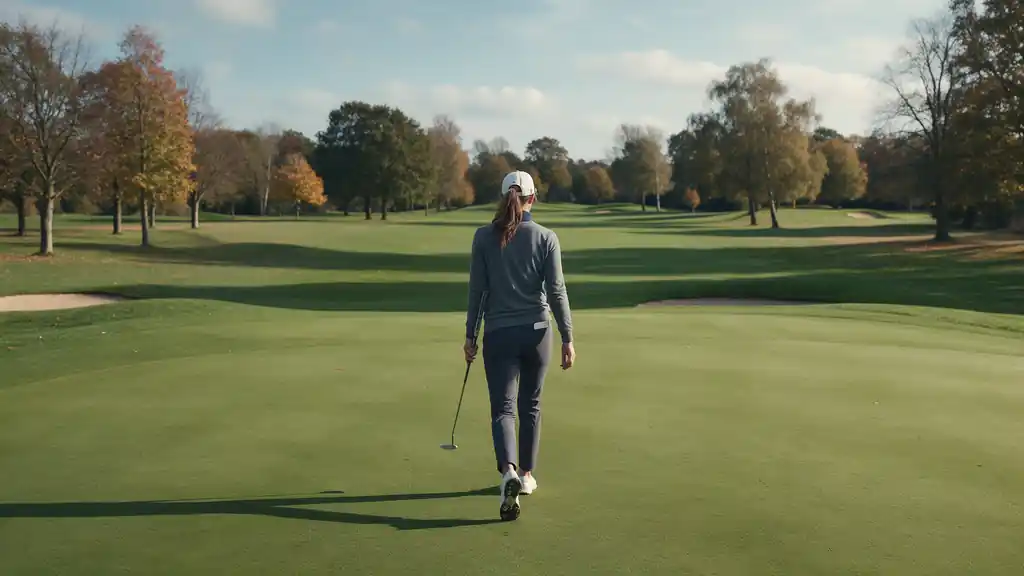
On the full swing, the same principle applies. A repeatable tempo is what lets you adjust: a slightly longer swing, a slightly firmer strike, without everything else falling apart.
3. Big moments reward simple routines
Kupcho holed a 91-foot putt on the 17th and a 30-footer on the 18th on Saturday evening to steal a fourball point, according to the BBC. Moments like that can swing momentum. Europe’s response on Sunday was not complicated: settled players, clear roles and a strong start from the top of the order.
You can borrow that for your own game. Have one routine you trust, and use it on every shot, whether it’s a 4-footer to win a match or a first tee shot in front of the clubhouse.
Bringing it back to your practice
None of this needs tour-level technology. It needs honest feedback and a little structure. A few ideas for this week:
- Pick one rhythm cue and keep it. Count “one, two” to the top, or use a three-word phrase. Repeat it on every practice swing.
- Practise a “pace change” session. Hit five shots with your normal swing, then five where you try to make the same swing a touch firmer without rushing the top. Compare how it feels.
- Check your head and hips under pressure. When golfers press, they often slide or lift. Film a few swings where you try to “hit it hard” and see what changes.
This is where DE-SHANK fits in. Prop your phone up, tap the mic and say “record”, and we’ll give you a score for tempo, head movement, hip sway and posture change on every swing. It runs on your phone, so your video never leaves it. You can read exactly how it works before you start.
DE-SHANK gives estimates from one camera view. It’s designed for practice feedback, to help you spot habits and track trends.
Our take
Europe’s win was built on big players finally getting their points, rookies who weren’t fazed and a captain who backed her instincts. For the rest of us, the takeaways are humbler but just as useful: don’t panic after a slow start, learn to adjust your pace, and keep your routine simple when it counts.
For more stories like this, browse our Golf News section.
Try DE-SHANK free
Want to see how steady your tempo really is when you’re under a bit of pressure? Try the free DE-SHANK beta. It’s free during the beta, and you don’t need any extra hardware.